The main structural moves
Rewrite to a common base before taking logarithms unnecessarily. When the same exponential repeats, substitute \(t=a^x\) and record \(t>0\). When reciprocal powers appear, symmetric quantities such as \(a^x+a^{-x}\) can create a short recurrence.
For logarithms, write the domain before combining expressions. An algebraic root that makes an argument non-positive is not an admissible logarithmic solution.
Inequalities depend on the base
An exponential or logarithmic function with base greater than one is increasing; a base between zero and one is decreasing. That difference controls whether an inequality direction is preserved or reversed.
In mixed questions, remove the \(\log\) or exponential layer first. The remaining problem may be a quadratic, a circle, a recurrence, a distance or a sign chart.
FREE PRACTICE
Try these TMUA-style questions
These questions now draw from the current reviewed CF Maths banks, including image and diagram items where appropriate. Open the solution only after you have committed to a route.
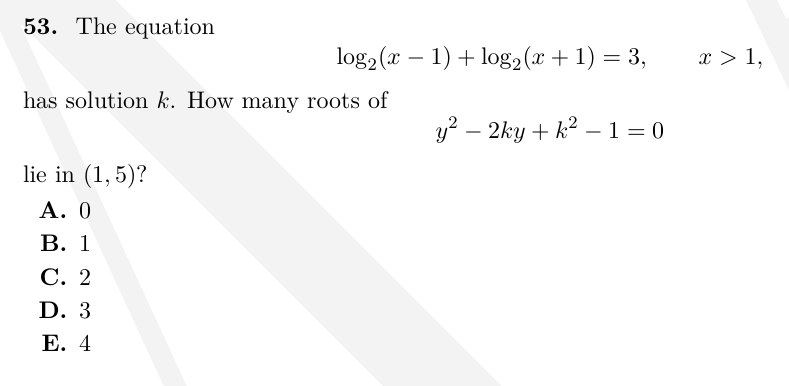
QUESTION 1 · Logarithmic equations & constraintsShow answer & route
Answer: C
Correct option: \(C\) - \(2\). Reduce the expression to a reversible algebraic condition; check domains, exclusions, discriminants or factor/remainder constraints before selecting the option.
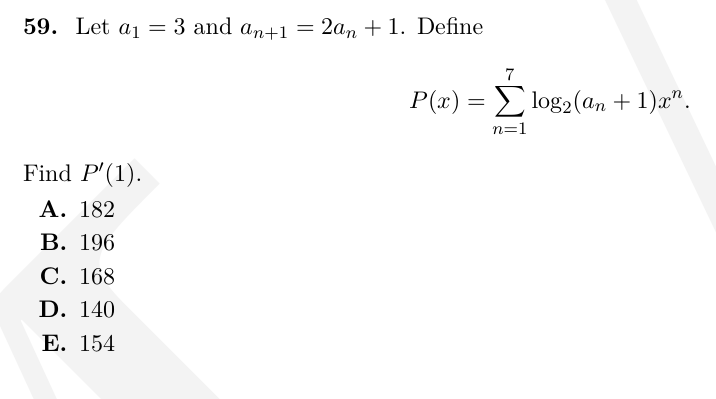
Show answer & route
Answer: B
Correct answer: \(B\). This item is marked from the validated final 200-question answer key. Revision method: Logarithmic equations & constraints. Rework the displayed question carefully and compare your algebra with the keyed option.
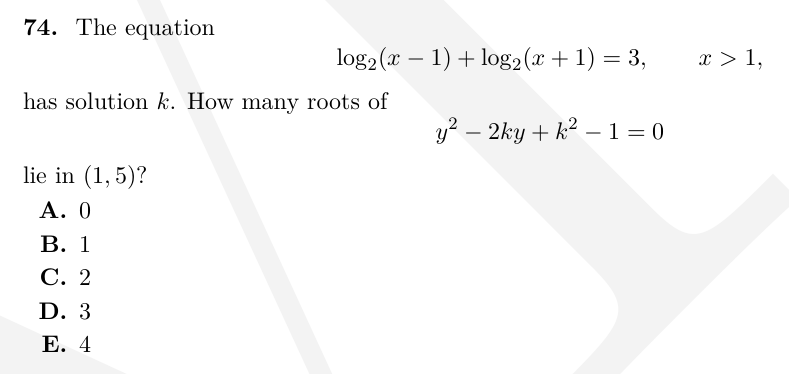
Show answer & route
Answer: C
Correct option: \(C\) - \(2\). Reduce the expression to a reversible algebraic condition; check domains, exclusions, discriminants or factor/remainder constraints before selecting the option.
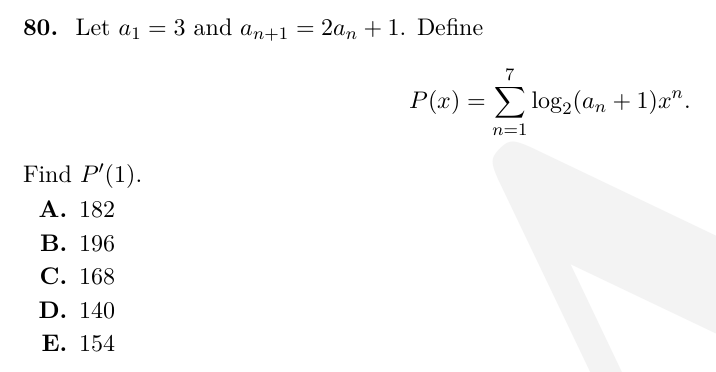
Show answer & route
Answer: C
Correct answer: \(C\). This item is marked from the validated final 200-question answer key. Revision method: Logarithmic equations & constraints. Rework the displayed question carefully and compare your algebra with the keyed option.
Show answer & route
Answer: C
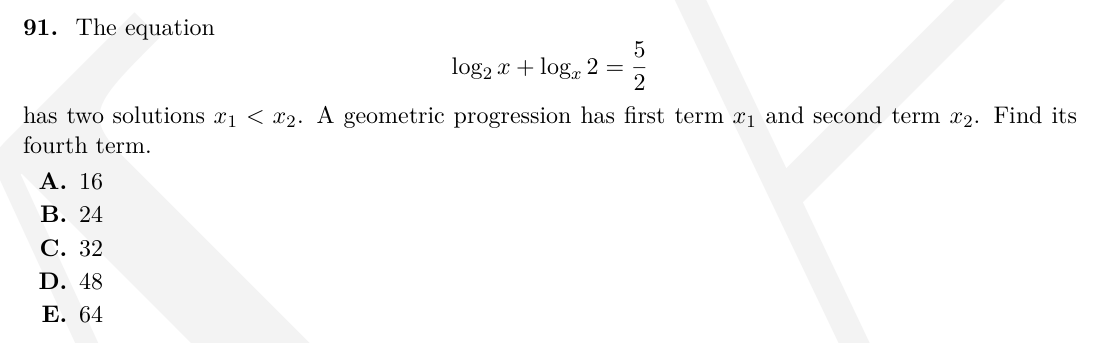
Let
\[y = \log_{2}x\]
Then
\[y+\frac{1}{y} = \frac{5}{2},\]
so
\[2y^{2}-5y+2 = 0\]
Thus
\(y = \frac{1}{2}\) or \(y = 2\),
giving
\[x_{1} = \sqrt{2}, x_{2} = 4\]
The common ratio is
\[\frac{4}{\sqrt{2}} = 2\sqrt{2}\]
Hence
\[u_{4} = \sqrt{2}(2\sqrt{2})^{3} = 32\]
Show answer & route
Answer: C
Correct answer: \(C\). This item is marked from the validated final 200-question answer key. Revision method: Logarithmic equations & constraints. Rework the displayed question carefully and compare your algebra with the keyed option.
Show answer & route
Answer: B
Correct answer: \(B\). This item is marked from the validated final 200-question answer key. Revision method: Logarithmic equations & constraints. Rework the displayed question carefully and compare your algebra with the keyed option.
Show answer & route
Answer: C
Correct answer: \(C\). This item is marked from the validated final 200-question answer key. Revision method: Logarithmic equations & constraints. Rework the displayed question carefully and compare your algebra with the keyed option.