State what the derivative is for
Before differentiating, decide what information you need. If the question asks for a decreasing interval, you need the sign of \(f'\). If it asks for a tangent, you need a gradient at a parameterised point. If it asks how many roots a polynomial can have, you need turning points and their heights.
This prevents long algebra with no clear target and makes parameter questions much easier to organise.
Root counting is a graph problem
For a polynomial equation \(P(x)+k=0\), treat \(-k\) as a horizontal level. Differentiate \(P\), find its turning points, evaluate their heights, and count how many monotone branches are crossed by that level.
Boundary values matter: when the level passes through a turning point, two intersections merge into one repeated root. That is why strict and non-strict parameter inequalities must be handled carefully.
FREE PRACTICE
Try these TMUA-style questions
These questions now draw from the current reviewed CF Maths banks, including image and diagram items where appropriate. Open the solution only after you have committed to a route.
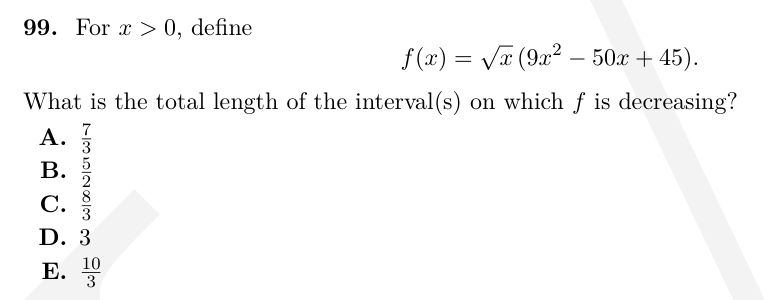
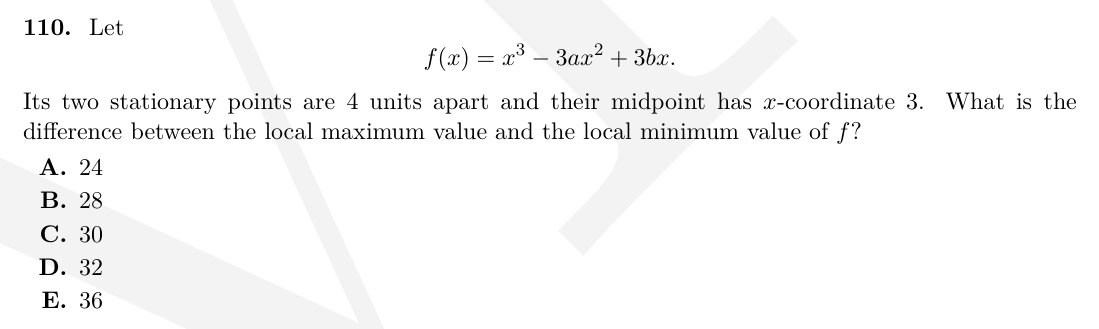
QUESTION 1 · Monotonicity & derivative signShow answer & route
Answer: C
Correct answer: \(C\). This item is marked from the validated final 200-question answer key. Revision method: Monotonicity & derivative sign. Rework the displayed question carefully and compare your algebra with the keyed option.
Show answer & route
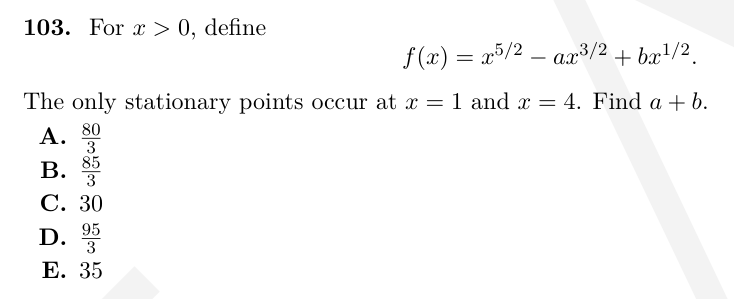
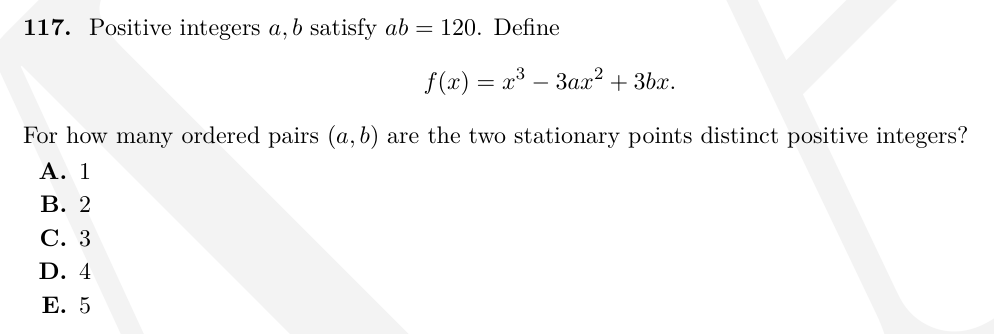
Answer: B
Correct answer: \(B\). This item is marked from the validated final 200-question answer key. Revision method: Stationary points & optimisation. Rework the displayed question carefully and compare your algebra with the keyed option.
Show answer & route
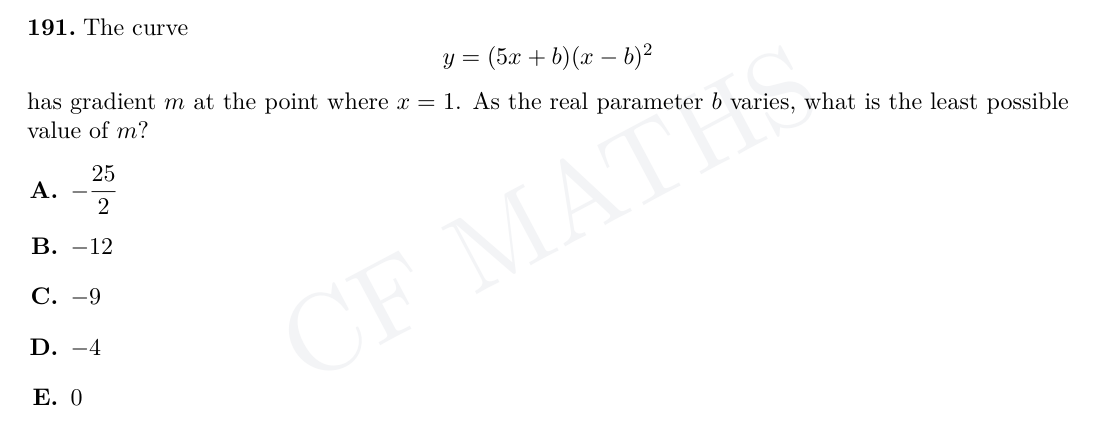
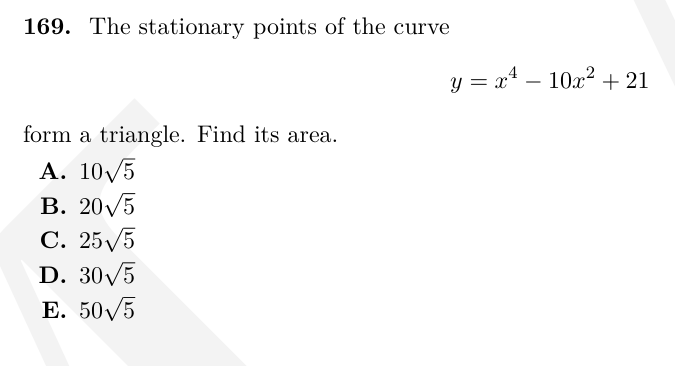
Answer: B
Correct answer: \(B\). This item is marked from the validated final 200-question answer key. Revision method: Gradients, tangents & normals. Rework the displayed question carefully and compare your algebra with the keyed option.
Show answer & route
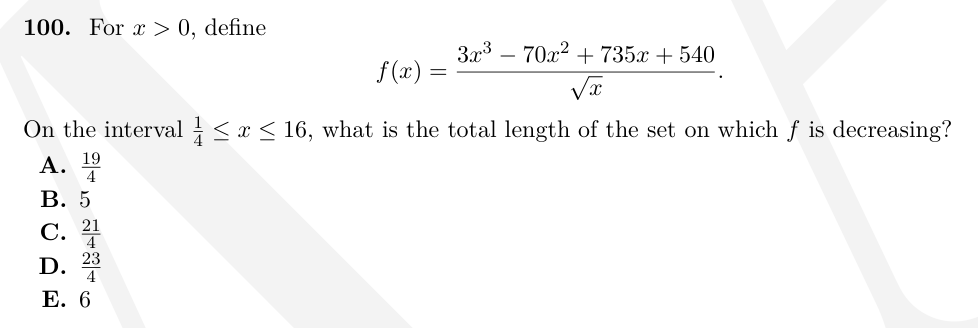
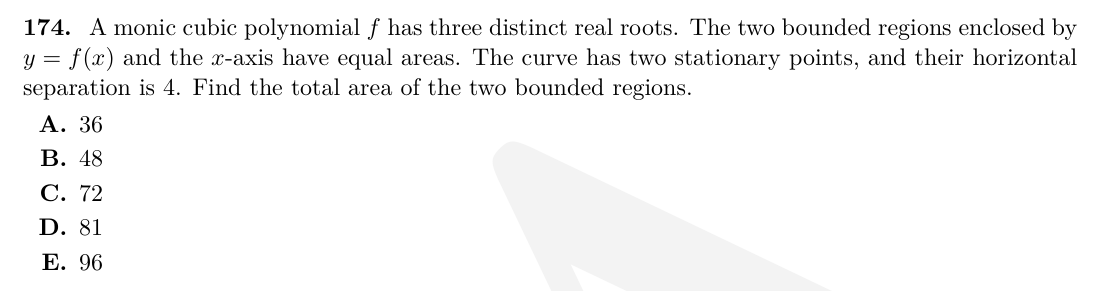
Answer: D
Correct answer: \(D\). This item is marked from the validated final 200-question answer key. Revision method: Monotonicity & derivative sign. Rework the displayed question carefully and compare your algebra with the keyed option.
Show answer & route
Answer: D
Correct answer: \(D\). This item is marked from the validated final 200-question answer key. Revision method: Stationary points & optimisation. Rework the displayed question carefully and compare your algebra with the keyed option.
Show answer & route
Answer: C
Correct answer: \(C\). This item is marked from the validated final 200-question answer key. Revision method: Stationary points & optimisation. Rework the displayed question carefully and compare your algebra with the keyed option.
Show answer & route
Answer: C
Correct answer: \(C\). This item is marked from the validated final 200-question answer key. Revision method: Stationary points & optimisation. Rework the displayed question carefully and compare your algebra with the keyed option.
Show answer & route
Answer: C
Correct answer: \(C\). This item is marked from the validated final 200-question answer key. Revision method: Stationary points & optimisation. Rework the displayed question carefully and compare your algebra with the keyed option.