Count branches, not formulas
Suppose the equation is \(P(x)=k\). The derivative partitions the graph into monotone branches. On each branch, a horizontal line can intersect at most once, so the root count is controlled by the relative position of \(k\) and the local extrema.
This is far more efficient than attempting a quartic or quintic formula, and it naturally handles questions asking for exactly one, three, four, five or more distinct real roots.
Boundary values create repeated roots
If the horizontal level passes exactly through a local maximum or minimum, the corresponding intersection is tangent to the graph and the root is repeated. Distinct-root counts therefore change precisely at turning heights.
For parameter intervals, calculate every turning height exactly, sort them, then test one level in each resulting interval. This turns an intimidating high-degree equation into a finite classification problem.
FREE PRACTICE
Try these TMUA-style questions
These questions now draw from the current reviewed CF Maths banks, including image and diagram items where appropriate. Open the solution only after you have committed to a route.
QUESTION 1 · Trapezium rule & numerical integrationShow answer & route
Answer: B
Correct answer: \(B\). This item is marked from the validated final 200-question answer key. Revision method: Trapezium rule & numerical integration. Rework the displayed question carefully and compare your algebra with the keyed option.
Show answer & route
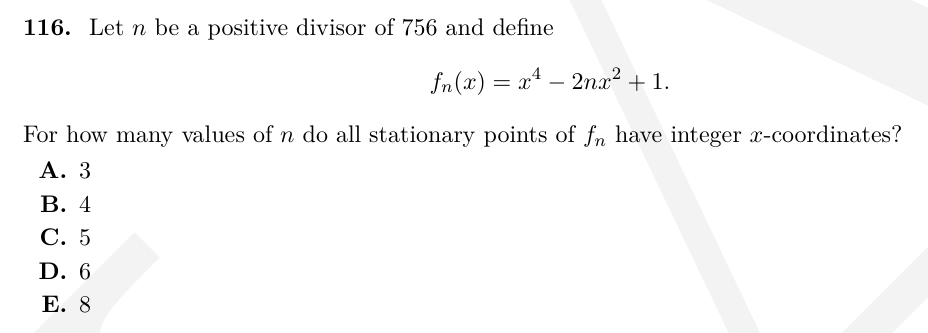
Answer: C
Correct answer: \(C\). This item is marked from the validated final 200-question answer key. Revision method: Stationary points & optimisation. Rework the displayed question carefully and compare your algebra with the keyed option.
Show answer & route
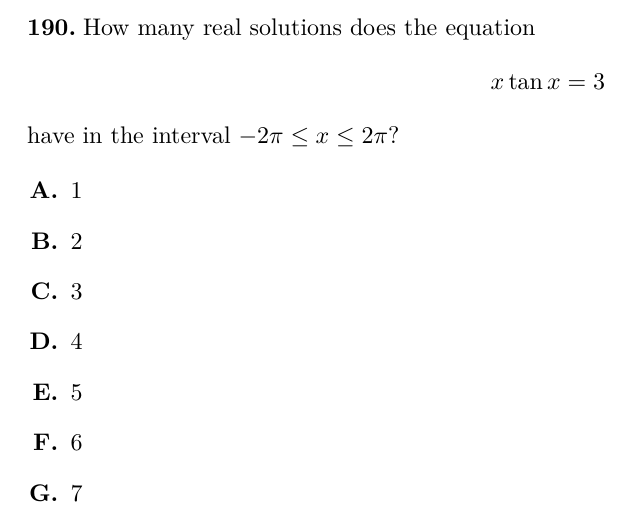
Answer: D
Correct answer: \(D\). This item is marked from the validated final 200-question answer key. Revision method: Trigonometric equations & root counting. Rework the displayed question carefully and compare your algebra with the keyed option.
Show answer & route
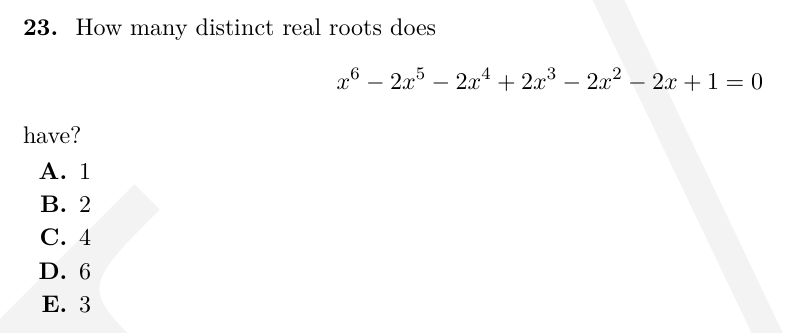
Answer: E
Correct answer: \(E\). This item is marked from the validated final 200-question answer key. Revision method: Polynomial roots & factors. Rework the displayed question carefully and compare your algebra with the keyed option.
Show answer & route
Answer: C
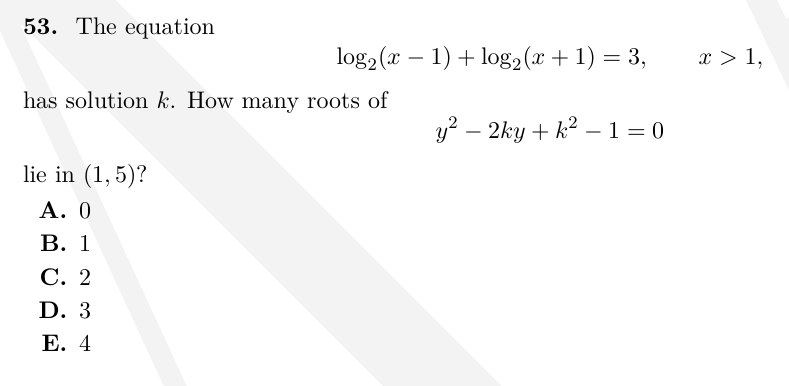
Correct option: \(C\) - \(2\). Reduce the expression to a reversible algebraic condition; check domains, exclusions, discriminants or factor/remainder constraints before selecting the option.
Show answer & route
Answer: A
Correct answer: A. This item is marked from the validated final 200-question answer key. Revision method: Circles, chords & tangents. Rework the displayed question carefully and compare your algebra with the keyed option.
Show answer & route
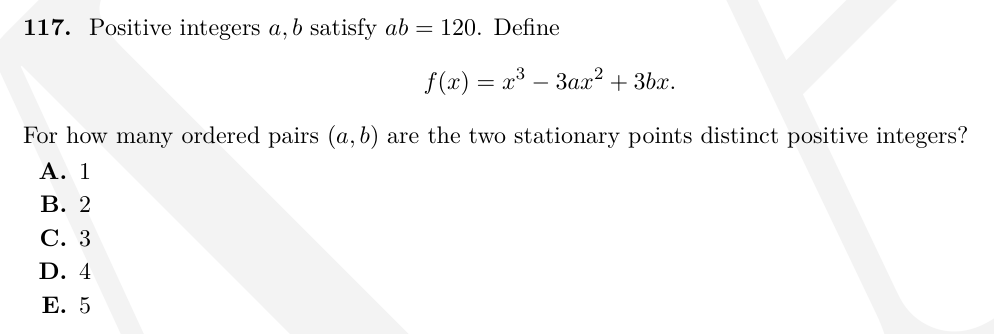
Answer: C
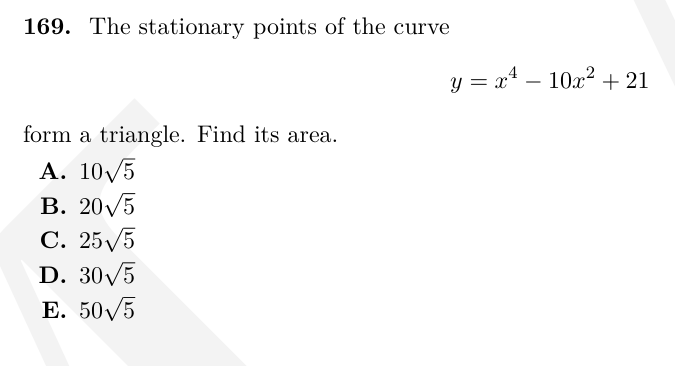
Correct answer: \(C\). This item is marked from the validated final 200-question answer key. Revision method: Stationary points & optimisation. Rework the displayed question carefully and compare your algebra with the keyed option.
Show answer & route
Answer: C
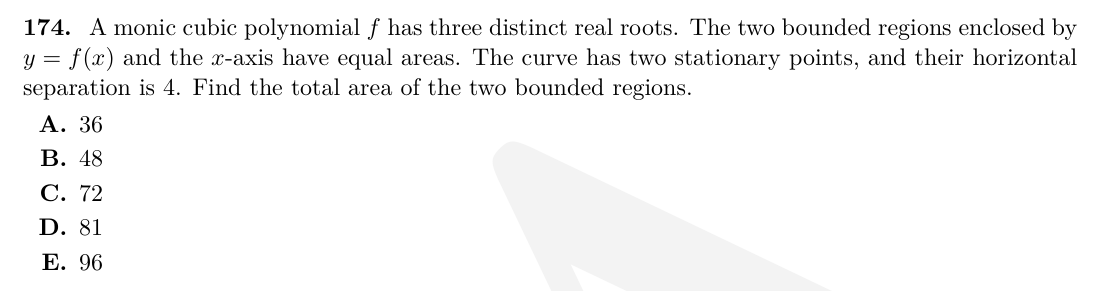
Correct answer: \(C\). This item is marked from the validated final 200-question answer key. Revision method: Stationary points & optimisation. Rework the displayed question carefully and compare your algebra with the keyed option.