The four logical possibilities
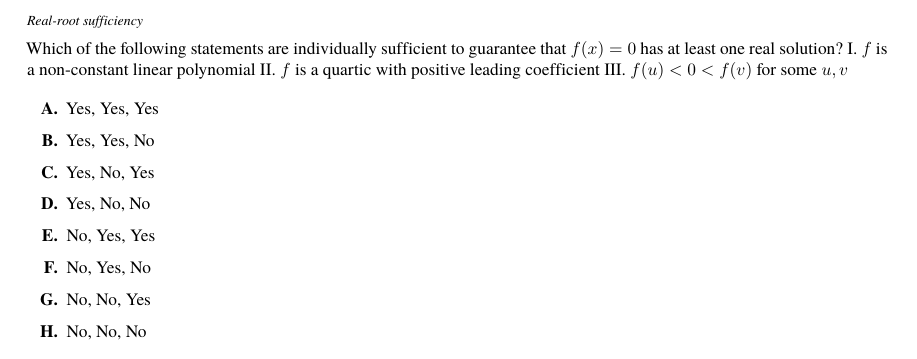
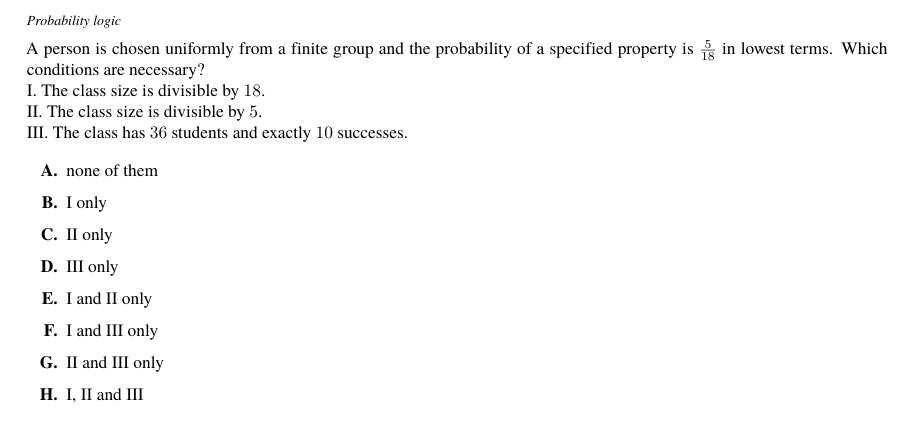
If A always leads to \(B\), then A is sufficient for \(B\) and \(B\) is necessary for A. If \(B\) always leads to A as well, they are necessary and sufficient for each other. If neither implication survives, the conditions are neither necessary nor sufficient.
A useful visual model is set containment: if every object satisfying A also satisfies \(B\), then the A-set sits inside the B-set. Equality of the sets corresponds to an if-and-only-if condition.
Do not confuse a common condition with an exact condition
A condition can be very useful and still fail to be necessary. For example, evenness guarantees equal integrals over mirrored intervals, but equal integrals can also occur for many functions that are not even.
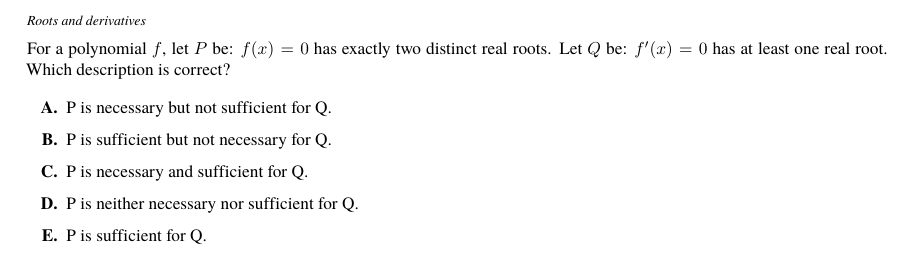
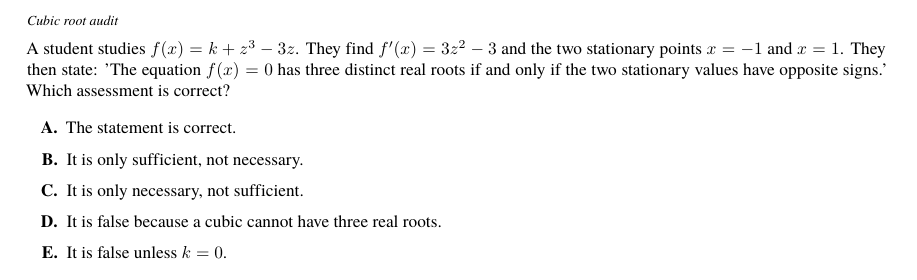
Likewise, two stationary points are not by themselves enough to guarantee three roots of a cubic; the turning values must lie on opposite sides of the axis. Exact conditions usually require the boundary cases to be checked explicitly.
FREE PRACTICE
Try these TMUA-style questions
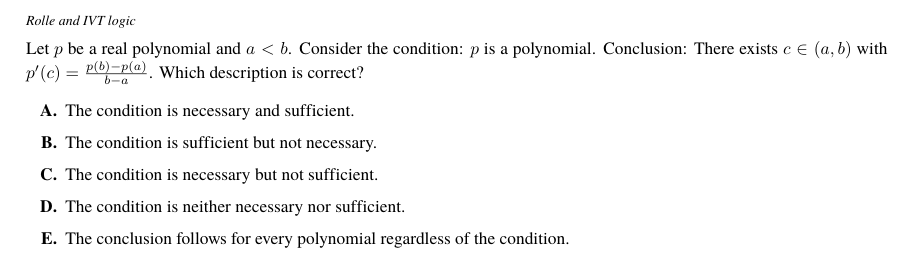
These questions now draw from the current reviewed CF Maths banks, including image and diagram items where appropriate. Open the solution only after you have committed to a route.
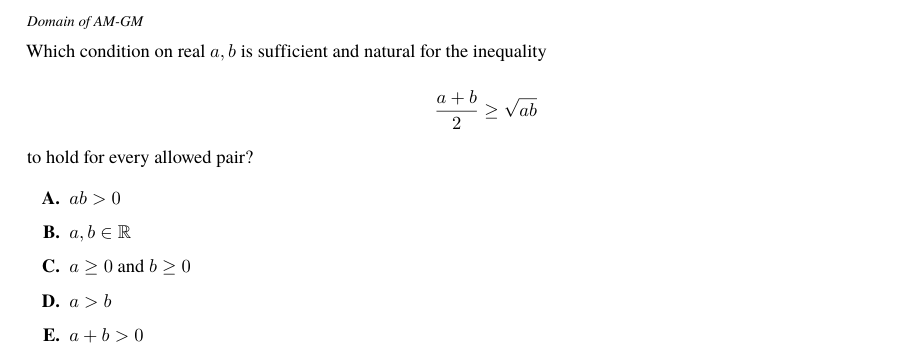
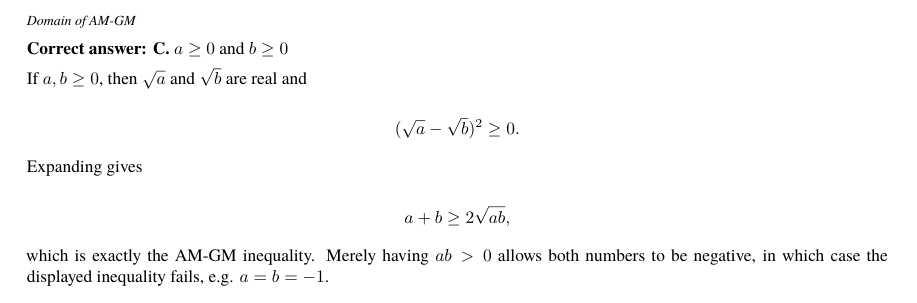
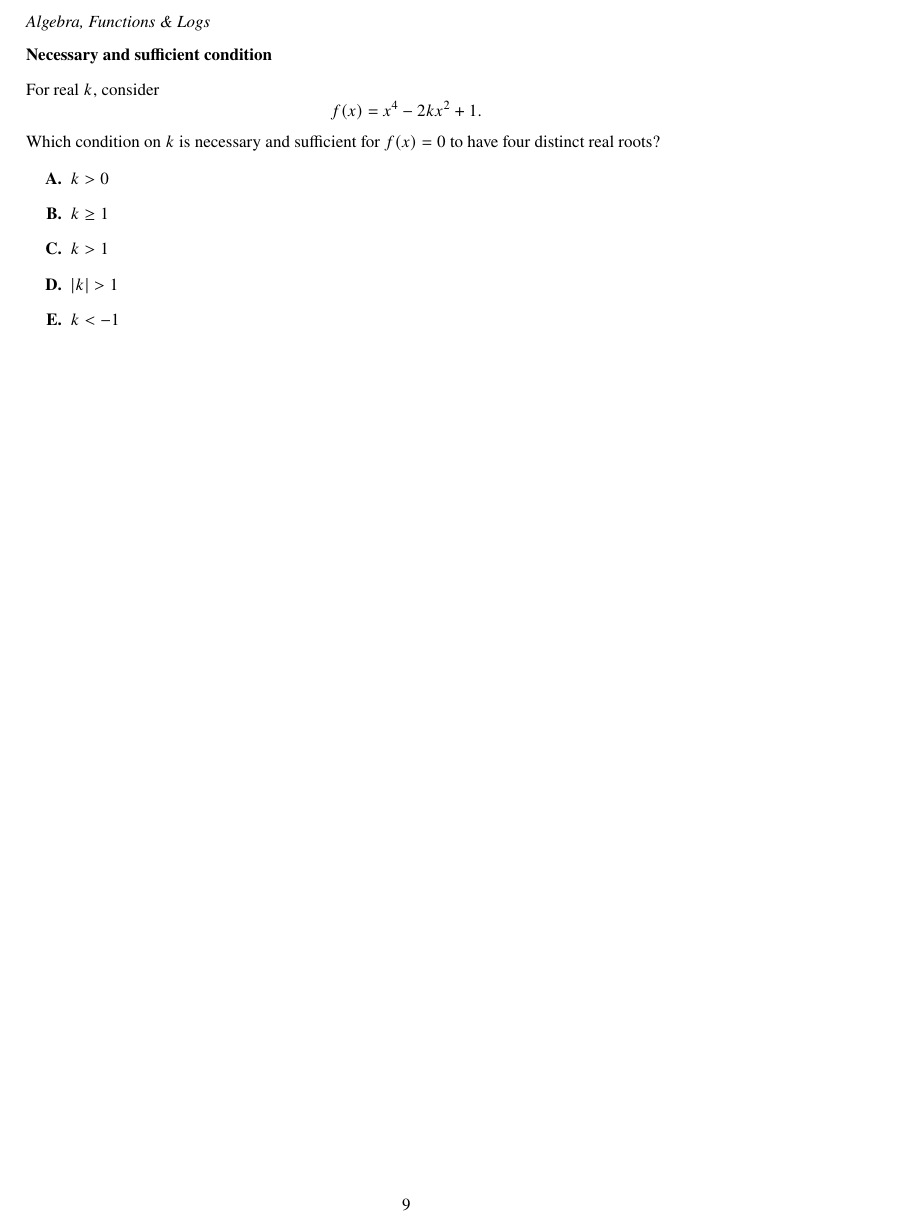
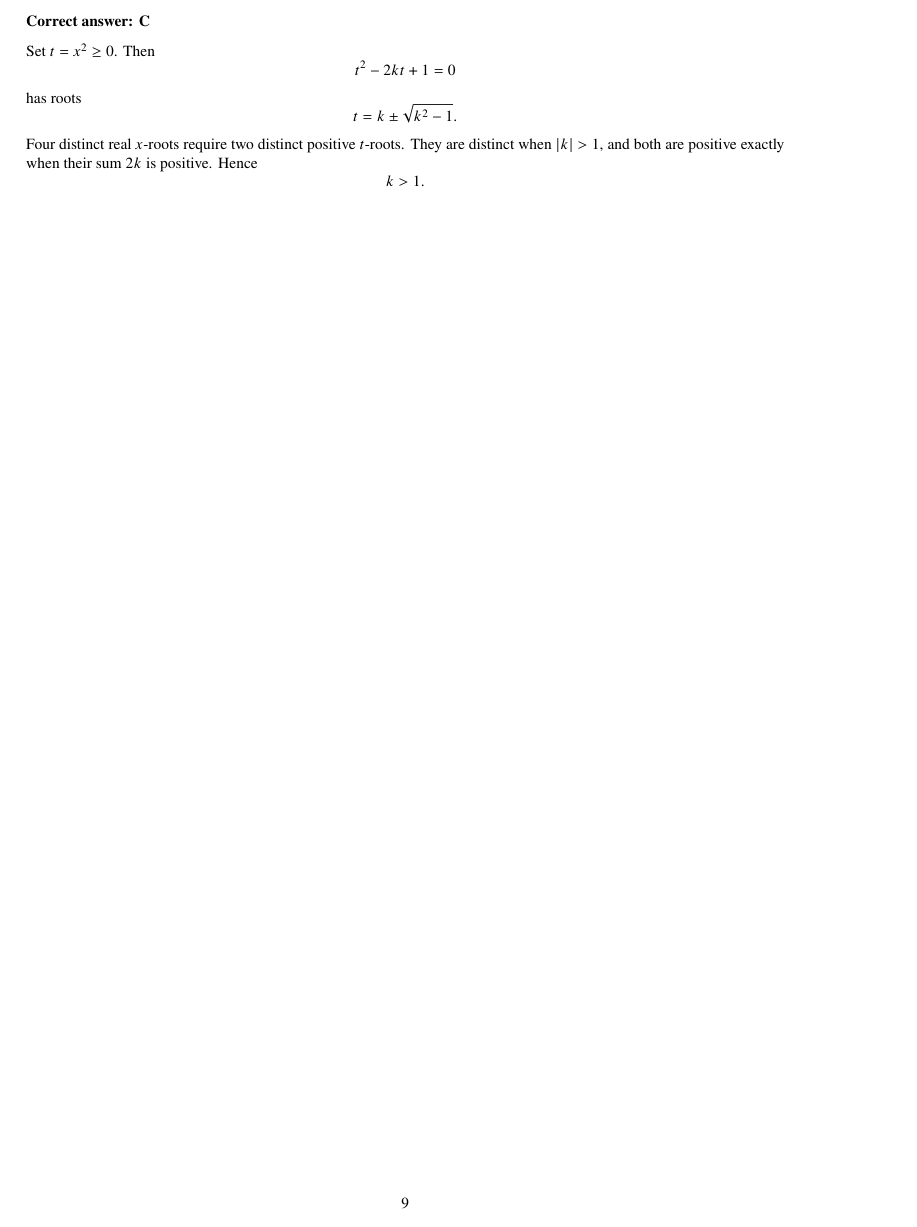
QUESTION 1 · Domain of AM-GMShow answer & route
Show answer & route
Show answer & route
Show answer & route
Show answer & route
Show answer & route
Show answer & route
Show answer & route